BIT 024
You Don't Need to Ban Thinking
September 23, 2026
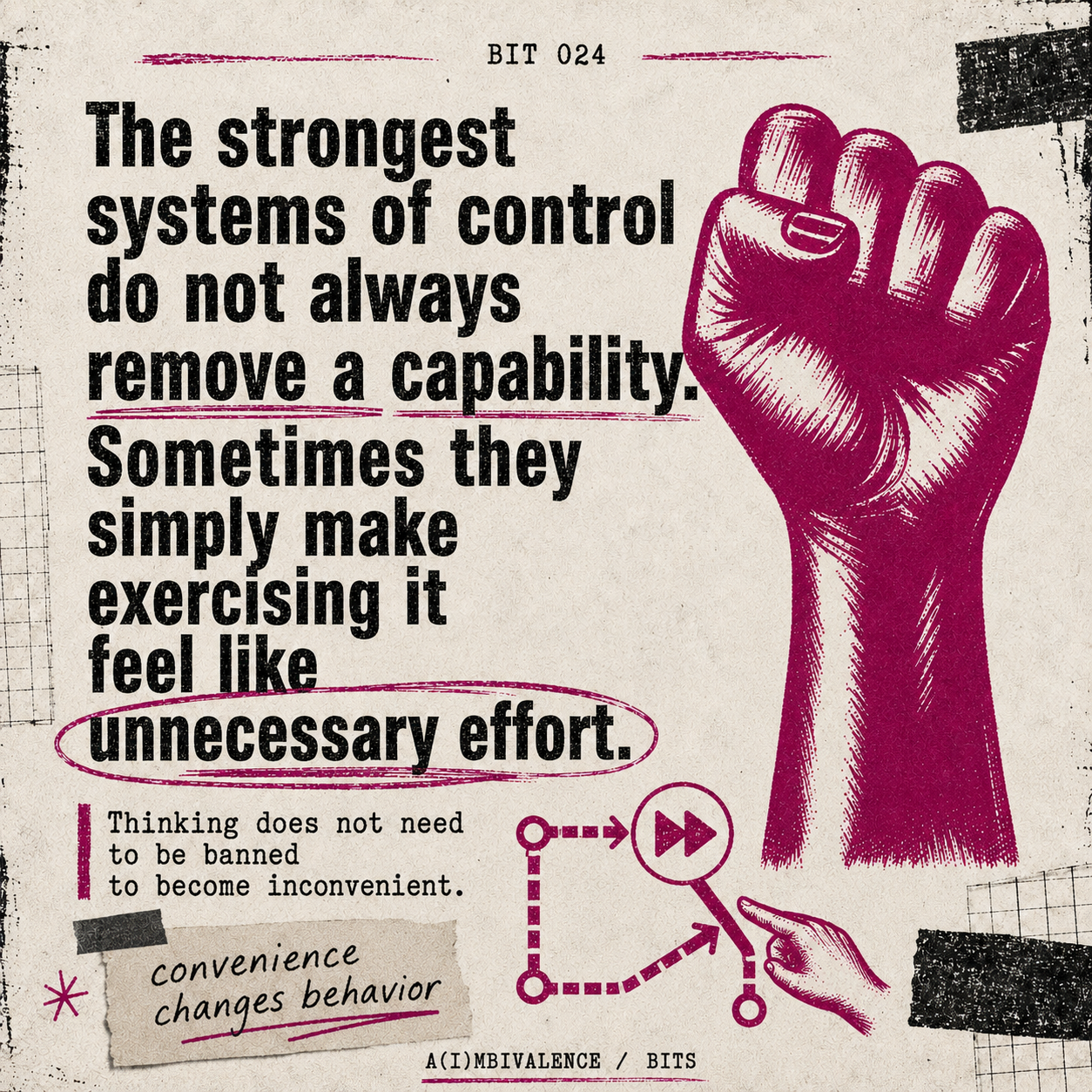
If you wanted people to think less independently, banning thinking would be an extraordinarily clumsy way to go about it. People tend to notice when things are forbidden. A much more effective environment would be one in which thinking remains completely permitted but gradually feels unnecessary. Why read the original document when there is a summary? Why struggle through an unfamiliar argument when you can ask for the conclusion? Why formulate the objection yourself when a system can generate five versions before you have finished the first sentence?
None of this requires anybody to have designed AI for the purpose of making people less capable of thinking. That is precisely why the structural effect is worth examining. Convenience changes behavior without requiring coercion. Once a sufficiently good shortcut exists, taking the longer route starts to feel irrational, even when the longer route was where some of the learning, judgment and intellectual independence actually happened.
Freedom therefore cannot only mean that a capability remains technically available. A society can preserve the right to think independently while building an environment in which exercising that right becomes increasingly unusual, inconvenient and economically disadvantageous. The strongest forms of control do not always need to remove a capability. Sometimes it is enough to make using it feel like unnecessary effort.