BIT 042
You Don't Need Evil Billionaires
October 19, 2026
It is comforting, in a strange way, to believe that the problem is a handful of uniquely horrible billionaires. Greedy, megalomaniacal, emotionally stunted men building machines nobody asked for while fantasizing about Mars, immortality and replacing the rest of us. There are certainly enough grotesque personalities available to sustain that story. But I think focusing too much on them lets the system off the hook. If all of this were happening because unusually bad people had accumulated unusually large fortunes, the solution would be almost reassuringly simple: get rid of the bad people and put some decent ones in charge.
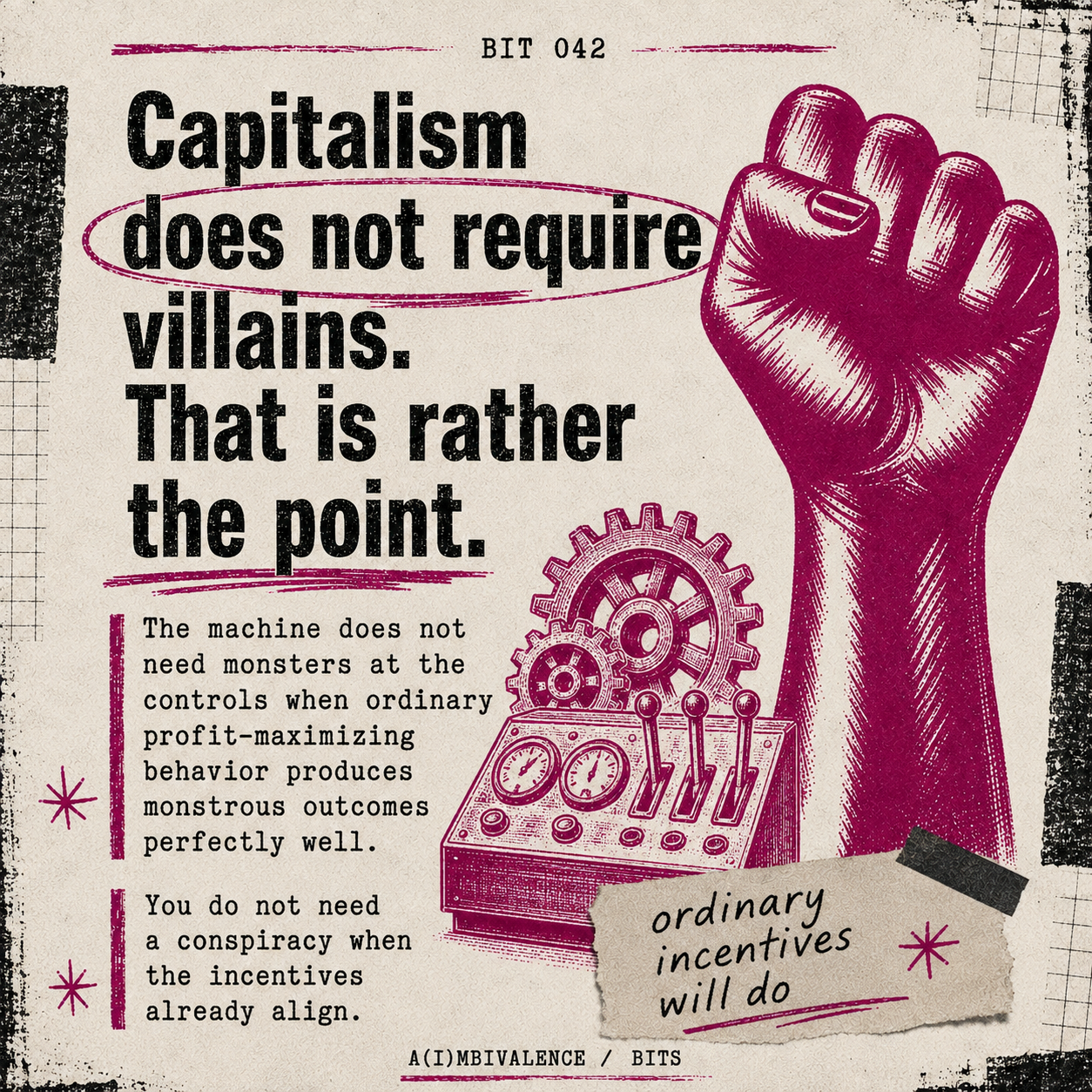
Capitalism does not require villains. That is rather the point. A perfectly pleasant CEO can exploit workers, extract public knowledge, burn obscene amounts of resources and eliminate thousands of jobs without waking up in the morning thinking, “How can I make the world worse today?” They merely have to behave rationally within a system that rewards growth, accumulation, market capture, lower labor costs and higher returns. Investors do not have to despise artists to profit from appropriating their work. Executives do not have to hate workers to celebrate needing fewer of them. Tech companies do not have to conspire in a smoke-filled room to move in remarkably similar directions when the same economic gravity pulls all of them there.
This is less cinematic than the evil-billionaire story and much more difficult to solve. You can humiliate a billionaire, remove a CEO, boycott a company, expose a hypocrite. Capital replaces personnel with astonishing ease. The machine does not need monsters at the controls when ordinary profit-maximizing behavior produces monstrous outcomes perfectly well. If we want different outcomes, we need to stop waiting for better rulers and start building structures in which it matters considerably less whether the person at the top happens to be benevolent.