BIT 004
We invented machines to save labor
August 16, 2026
There is something deeply absurd about being afraid of a machine because it can do less work for us. Reducing necessary human labor is, in principle, fantastic. If a machine can perform in ten minutes what previously required ten hours of tedious human work, that should be good news: we have gained nine hours and fifty minutes of human life.
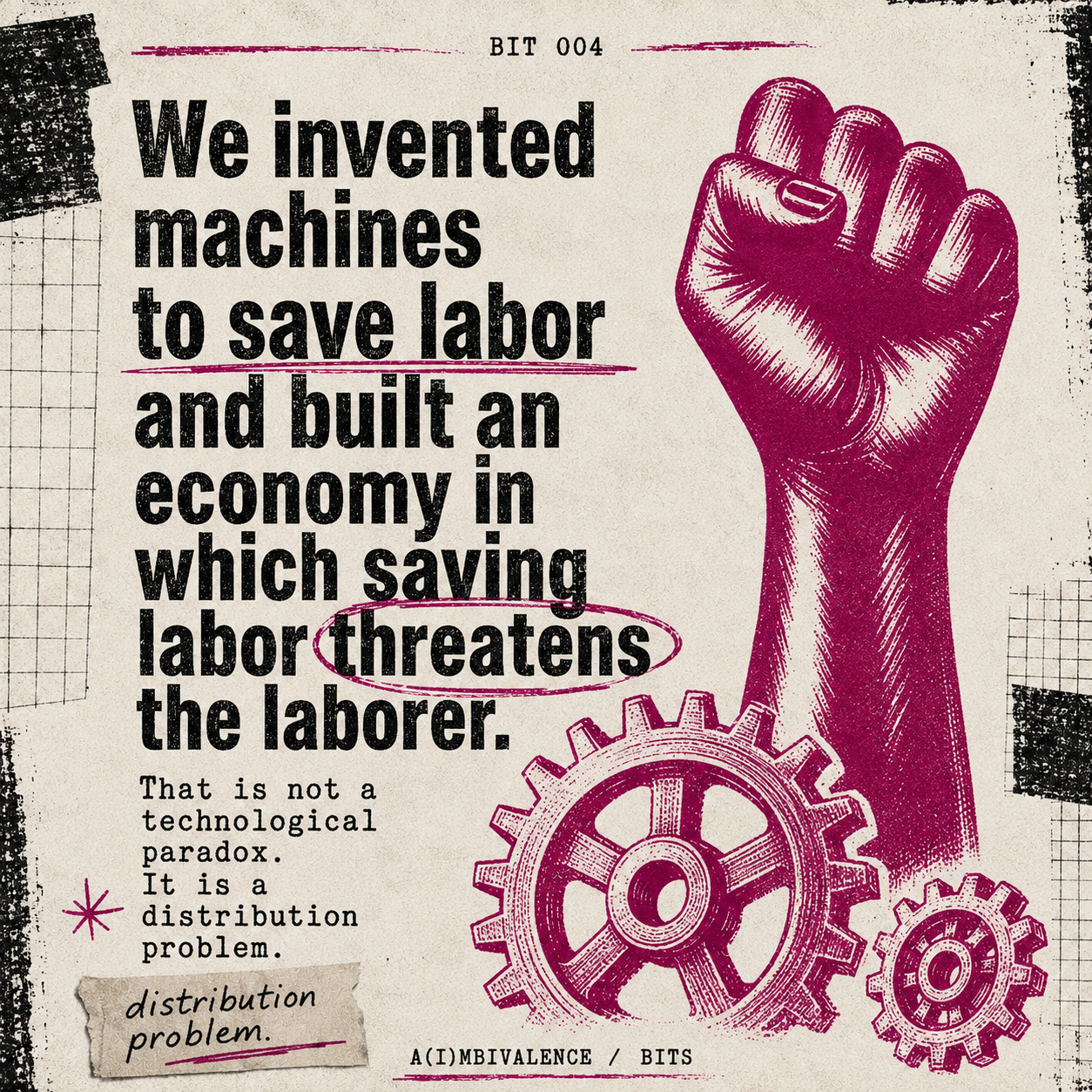
Except that this is not how we experience automation. Instead, the worker starts wondering whether they will still have a job. Think about how strange that is: we invented machines to save labor, and then built an economy in which saving labor threatens the person whose labor was saved.
The contradiction becomes particularly obvious with AI, because it reaches into kinds of work that many people assumed were protected from automation. Suddenly we are discussing whether we will still need as many programmers, translators, designers, accountants, lawyers, customer-service workers, writers, analysts, administrators, and countless others. And the dominant political response is to protect our employability: learn AI, reskill, upskill, become more productive, make yourself indispensable.
Almost nobody asks the more interesting question. If we genuinely need fewer hours of human labor to produce the things and services society needs, why is that not something to celebrate? Why does a productivity breakthrough arrive as a threat rather than a dividend?
There is no law of physics saying that a 30 percent productivity increase must become 30 percent more output, 30 percent fewer workers, or higher returns to owners. It could also become shorter working weeks, more holidays, earlier retirement, better staffing, or more time for care, family, community, politics, art, boredom, or doing absolutely nothing useful whatsoever. We could collectively decide that increasing productivity means needing less of people’s lives, but that requires treating productivity gains as something society has a claim on, rather than something that automatically belongs to whoever owns the productive infrastructure.
The real promise of automation was never that humans could produce infinitely more. It was that humans might eventually have to work less. Perhaps we should stop allowing that promise to quietly disappear every time the technology actually gets good enough to deliver it.