BIT 009
We are automating both sides of the bargaining table
September 1, 2026
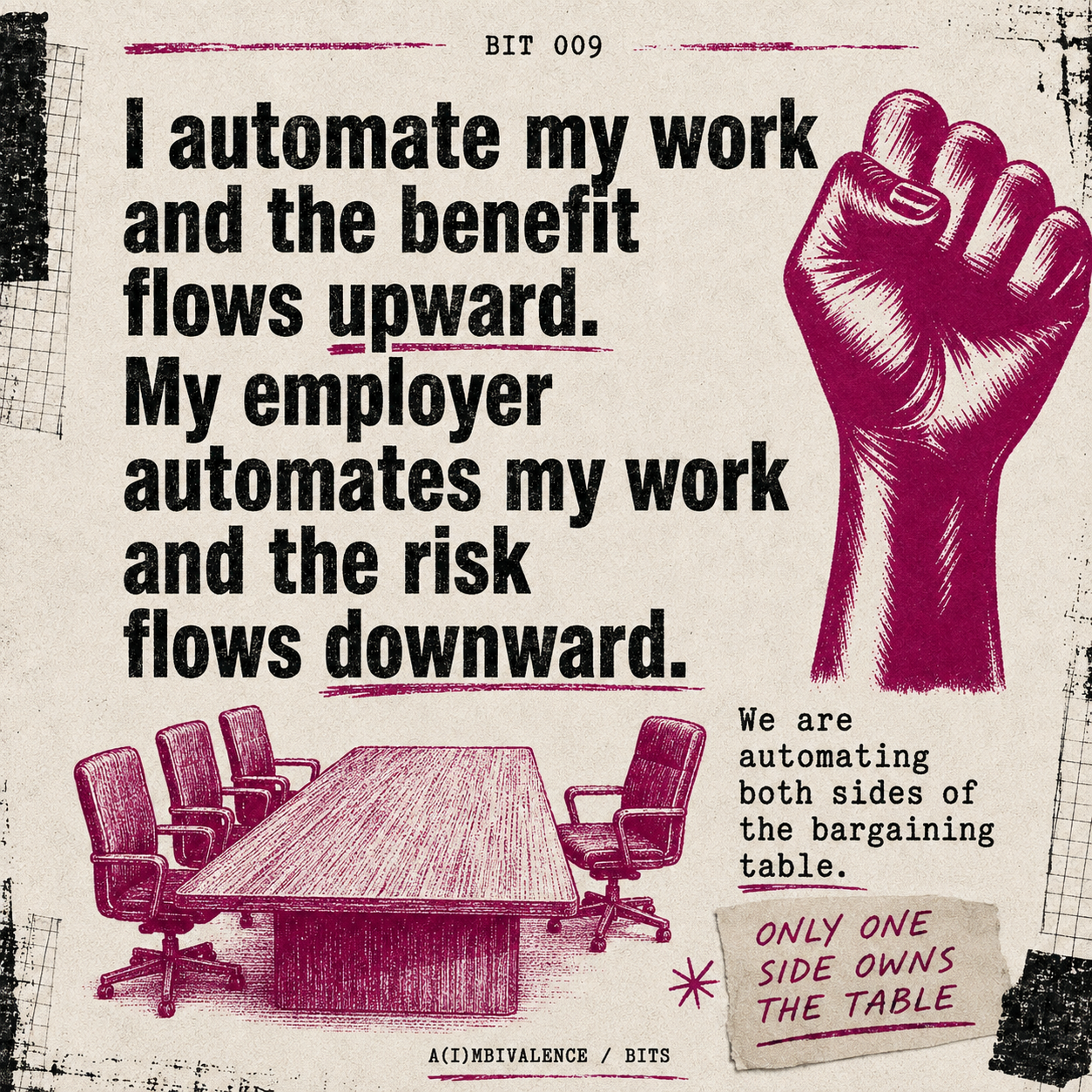
There is a strange asymmetry in how workers and companies are being told to use AI. Workers are told to automate as much of their work as possible: write faster, code faster, research faster, summarize faster, automate the repetitive parts, become more efficient, increase your output, make yourself more valuable.
Companies are also told to automate as much work as possible: reduce costs, increase margins, scale without increasing headcount, do more with fewer people. Those sound like the same productivity story. They aren’t.
If I use AI to reduce a four-hour task to one hour, I usually do not receive three hours of my life back. I have created three hours of additional capacity for my employer. If my employer discovers that AI reduces the amount of human labor required across an entire department, however, those saved hours suddenly become very relevant: a hiring freeze, restructuring, fewer contractors, smaller teams, redundancies. I automate my work and the benefit flows upward. My employer automates my work and the risk flows downward. And somehow both processes are presented to workers as reasons to become even more productive. This creates a rather peculiar bargaining position. We are encouraged to enthusiastically help build the evidence that more output can be produced with less of our labor, while having very little power over what happens once that evidence becomes convincing. That does not mean workers should refuse to use AI. Individual refusal is unlikely to solve a structural problem, particularly when using the tools may genuinely make work easier. But we should at least recognize the asymmetry. If productivity gains are collectively produced while their benefits remain privately controlled, becoming more efficient does not necessarily make workers more powerful. Sometimes it simply makes fewer workers necessary. We are automating both sides of the bargaining table. But only one side owns the table.