BIT 002
The time AI saves is not yours
August 8, 2026
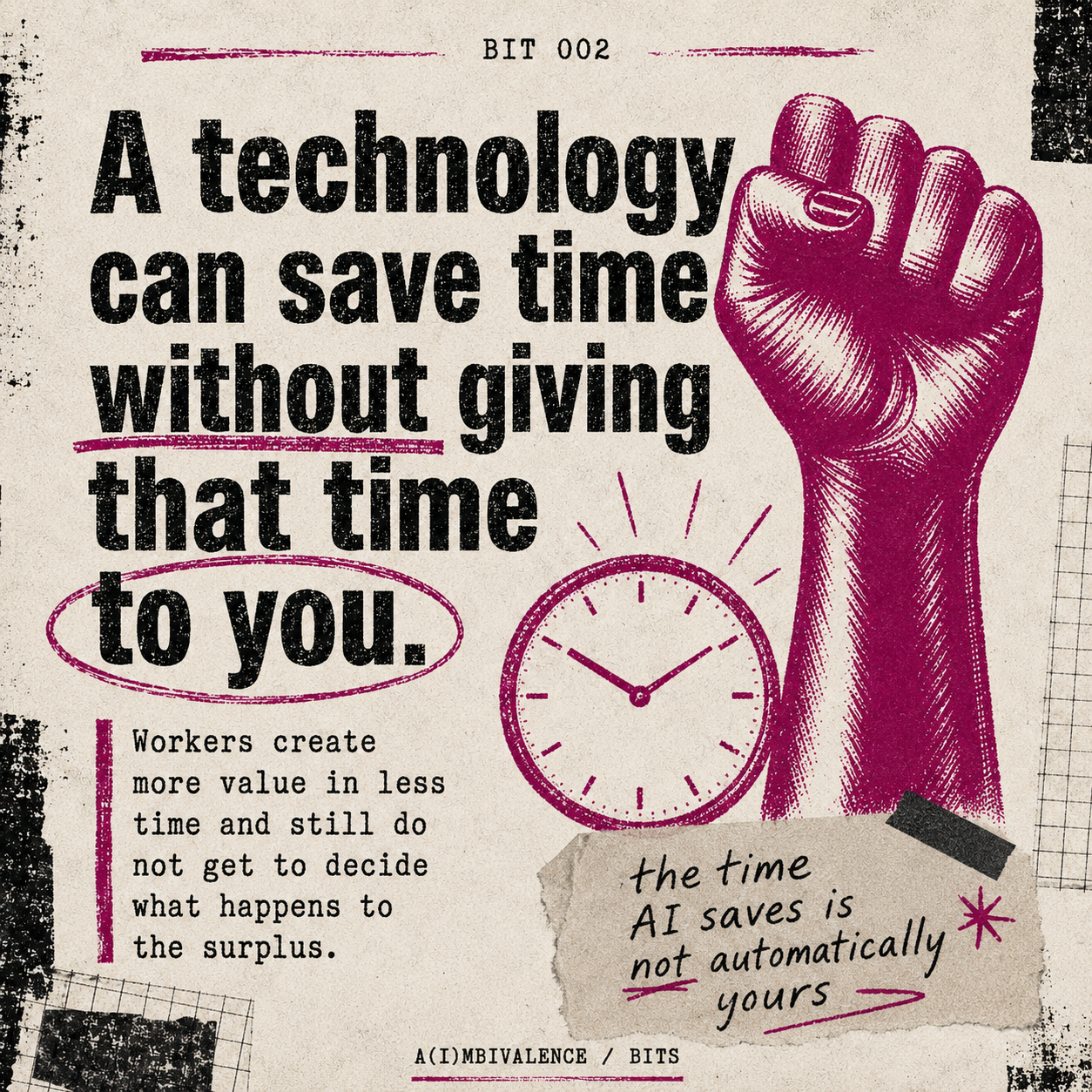
One of the promises of AI is that it will save us time, and it probably will. The interesting question is what happens to the time it saves.
Imagine a task that used to take you ten hours now takes five. Those five hours did not magically become yours. You do not get to leave work at lunchtime because productivity improved. In most workplaces, you are still employed for the same number of hours. So the five hours you saved become capacity for more work.
The same applies at a larger scale. If AI allows a company to produce the same output with considerably less human labor, there is nothing inherent in that productivity gain that turns it into shorter working hours, higher wages, more holidays, or an easier workload.
Workers created more value in less time. But workers generally do not decide what happens to that surplus. The company can reduce working hours while keeping salaries stable. It can increase wages. It can hire enough people to make workloads humane. Or it can increase output, reduce headcount, increase margins, return money to shareholders, and tell the remaining employees that AI has created exciting new opportunities for them to focus on “higher-value work”.
The technology does not make that decision. Ownership does. This is why I am increasingly suspicious of the phrase “AI saves time”. It describes a technical capability as if it automatically produced a social benefit. A technology can save time without giving that time to you. We have spent centuries inventing machines that reduce the amount of human labor necessary to produce things. Yet somehow the reward for needing less labor is often that workers have to produce more, work faster, or fear becoming unnecessary.
That is not a technological paradox, but a distribution problem, and unless workers have considerably more say over how productivity gains are distributed, AI may indeed save an extraordinary amount of labor. Just not necessarily for the people doing it.