BIT 027
The Right to Be Difficult
September 28, 2026
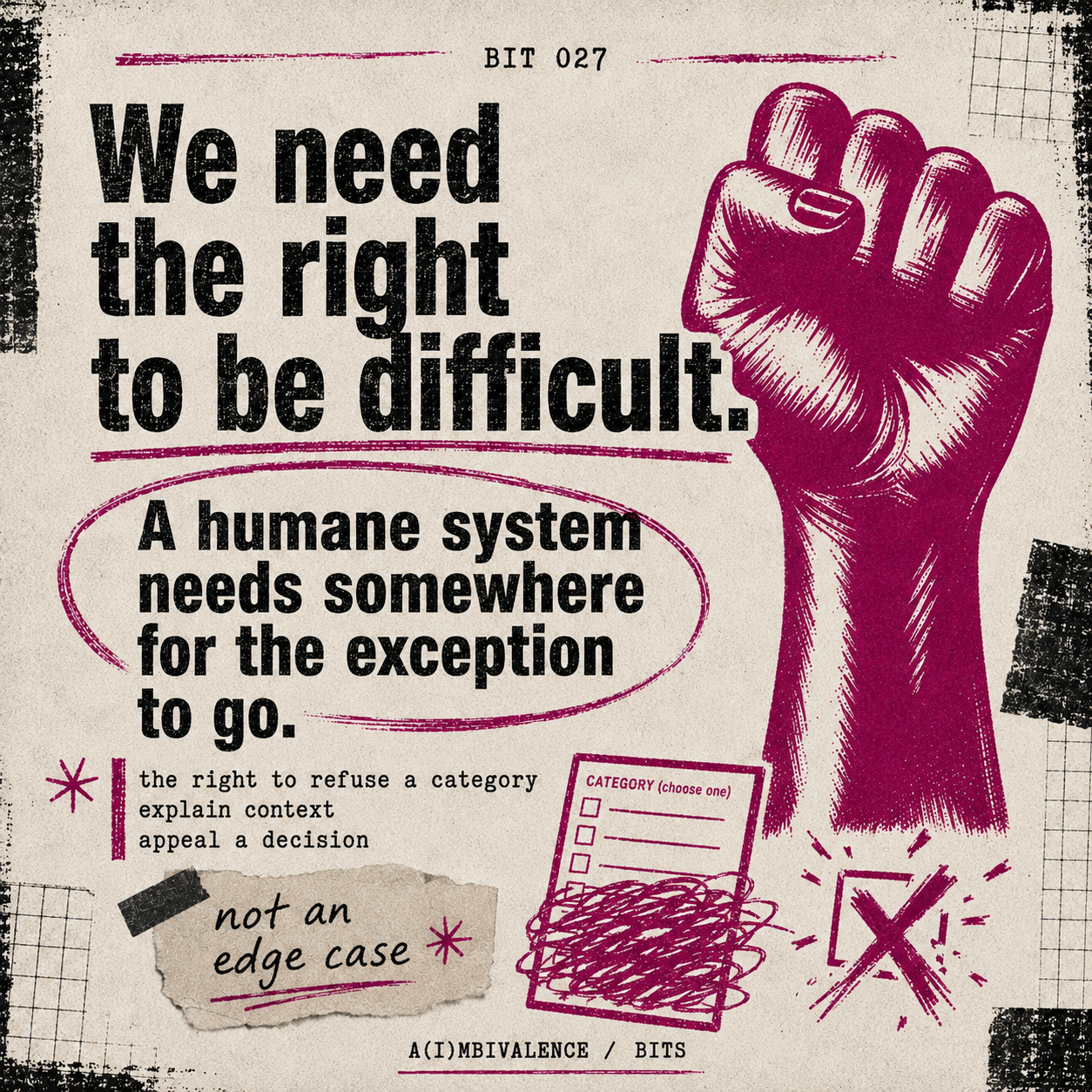
Automated systems love people who fit. Complete records, recognizable patterns, standard cases, predictable needs. Institutions love them too, because standard cases scale. The difficult person is the one whose life does not match the dropdown, whose circumstances contradict the available data, who needs an exception, wants to explain something nobody provided a field for, or insists that the technically correct classification is still wrong.
As more administrative and organizational decisions become automated or AI-assisted, we will need more than transparency and privacy. We need the right to be difficult. The right to demand human review, contest an inference, refuse a category, explain context, appeal a decision and take up considerably more time than the optimized process allocated to us. Not because every individual is always right, but because no model of reality becomes reality merely by being sufficiently scalable.
A humane system needs somewhere for the exception to go. A democratic one needs more: it must allow the exception to challenge the rule itself. Efficiency wants the messy human to become legible to the system. Rights sometimes require the system to become accountable to the messy human. The right to be difficult is therefore not an unfortunate concession we make to edge cases. It is part of what prevents people from becoming edge cases in their own lives.