BIT 047
The Opposite of Personalization
October 26, 2026
Personalization has become such an unquestioned synonym for good technology that its opposite sounds almost like a defect. Why would I want irrelevant recommendations, unfamiliar people, things that do not match my preferences? The entire digital environment is being trained to know me better: my taste, politics, habits, history, writing style, vulnerabilities, desires. Generative AI promises the culmination of this logic, an interface that does not merely know what I clicked yesterday but increasingly knows how I speak, what I care about and what kind of answer is likely to work for me. Everything becomes more relevant, more convenient, more me.
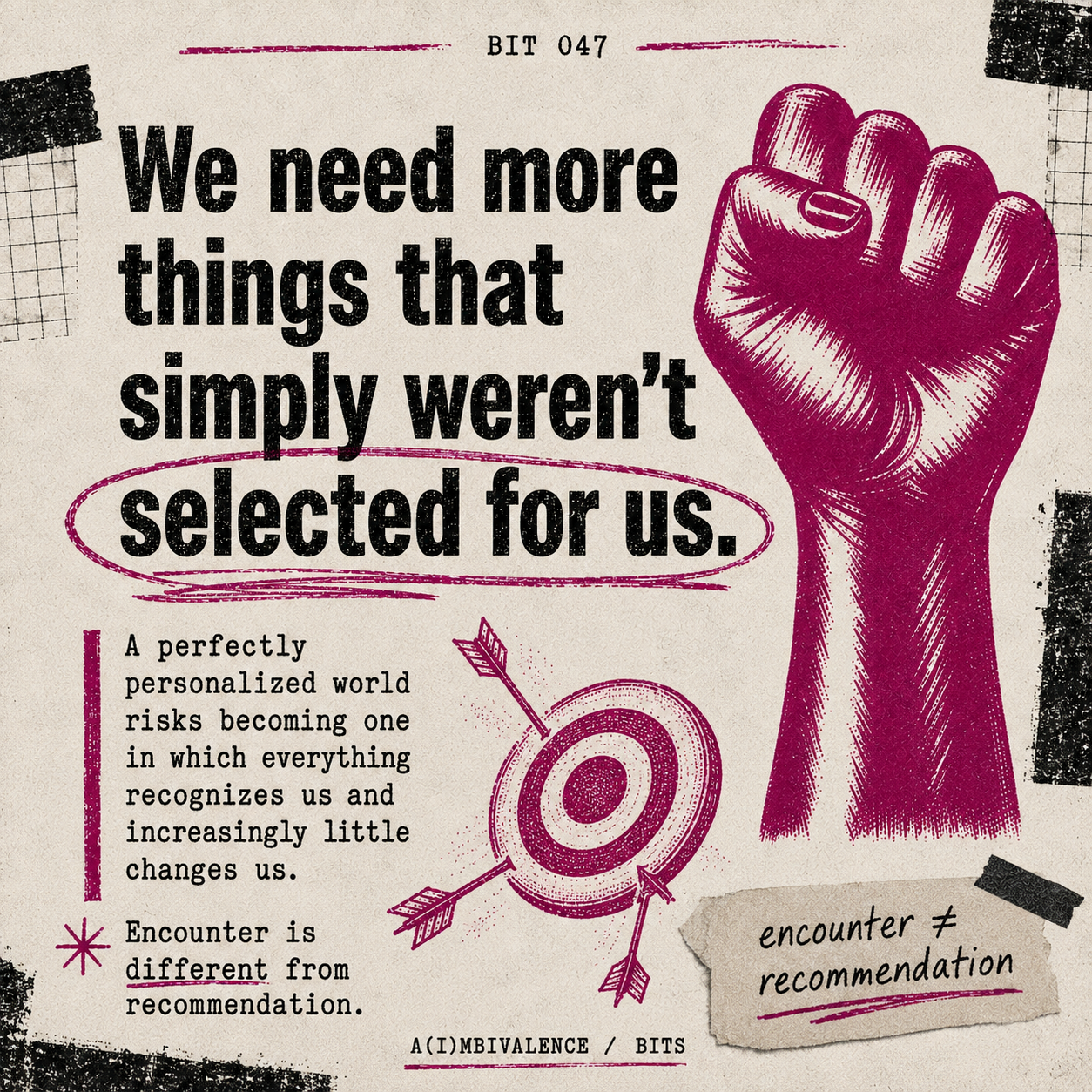
But there is value in encountering things that were not selected for us. The strange book beside the one we came to find. The band playing in a bar we happened to enter. The person at the community meeting whose politics annoy us. The conversation we did not ask for. The idea that initially seems irrelevant because no system had enough evidence to predict that we might become interested in it. Other people are particularly inconvenient in this regard. They insist on bringing things into our lives that do not correspond to our preferences. This is part of what makes encounter different from recommendation. Serendipity requires some loss of control over what gets through.
A perfectly personalized world risks becoming one in which everything recognizes us and increasingly little changes us. That matters far beyond culture or entertainment. Learning requires discovering what we did not know we needed to know. Democracy requires sharing a world with people we would never have selected for ourselves. Collective power requires discovering common ground with people who do not fit neatly into our preferred categories. Perhaps a functioning society needs spaces that do not know us, people who were not matched to us, ideas nobody predicted we would like and considerably more things that simply weren’t selected for us.