BIT 008
Technology does not contain its politics
August 29, 2026
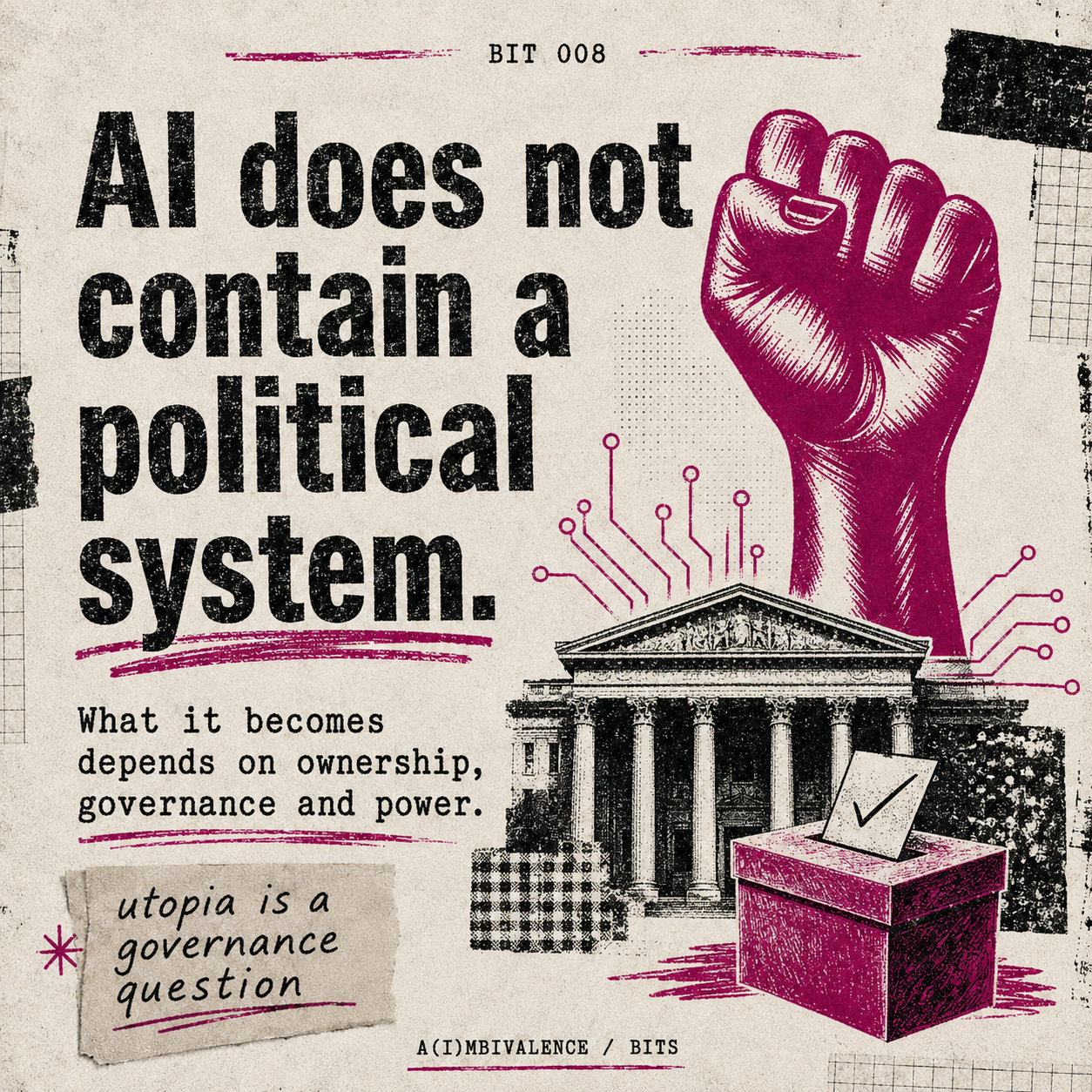
People keep asking whether AI will create utopia or dystopia. I think the question gives technology far too much responsibility: AI does not contain a political system.
The same underlying technological capability could help create a society in which people work considerably less, knowledge becomes broadly accessible, dangerous and tedious work is automated, public services improve, and productivity gains translate into more human freedom. Or it could help create a society in which a tiny number of companies own an extraordinary amount of productive infrastructure, workers become increasingly replaceable, public institutions depend on private platforms, surveillance becomes cheap and ubiquitous, and everyone else rents access to systems they cannot meaningfully control.
Same technology. Very different society. Which version we get depends on rather boring-sounding questions that somehow receive much less attention than whatever the newest model can do: Who owns it? Who governs it? Who can inspect it? Who gets access? Who carries the risk? Who receives the productivity gains? Who can refuse it? Who can contest a decision? Who has power when interests conflict? Those are political questions, not technical ones. This is why I find both technological utopianism and technological doom strangely unsatisfying: both can make the technology itself the protagonist of history. It isn’t. AI gives us new capabilities. What those capabilities become in society depends on power. Utopia is not a feature of the technology. It is a governance question.