BIT 044
Inefficiency as Resistance
October 21, 2026
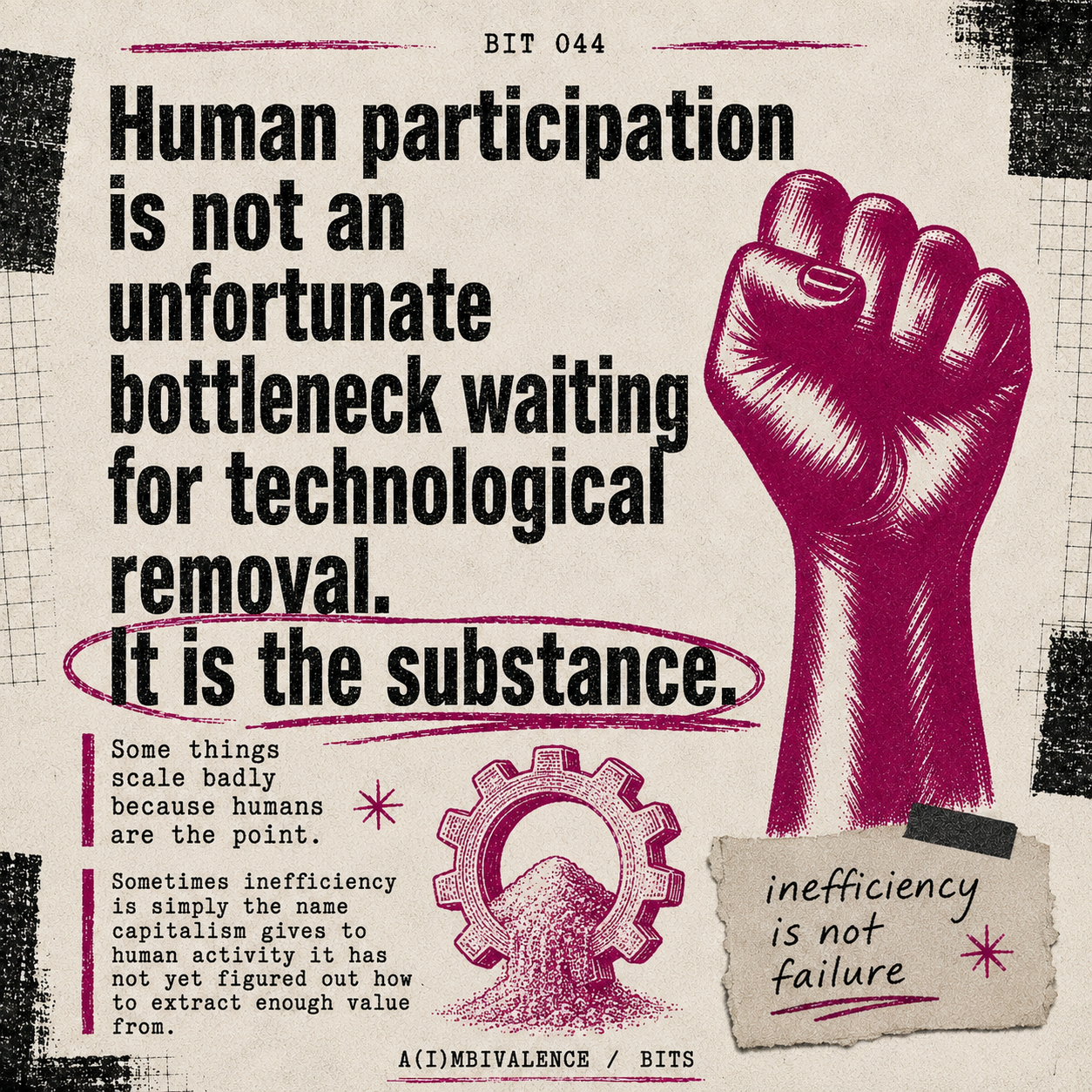
I have started to think that inefficiency needs political rehabilitation. We have spent decades treating efficiency as if it were a morally neutral synonym for improvement: faster, cheaper, smoother, scalable, optimized. AI merely intensifies an obsession that was already there. Yet an extraordinary amount of what makes human life tolerable is scandalously inefficient. Friendship. Care. Democracy. Learning. Art. Grief. Organizing. Falling in love. Sitting beside somebody who is having the same terrible conversation for the fifth time because apparently they need to have it a sixth.
These things scale badly because human participation is not an unfortunate bottleneck waiting for technological removal. It is the substance. Care without time becomes processing. Democracy without obstruction becomes administration. Learning without struggle becomes retrieval. Friendship without inconvenience becomes networking. Art without the troublesome business of making can still produce beautiful objects, but we should at least ask what else disappeared when production became instantaneous. The fixation on efficiency keeps making the same category error: it assumes that because an outcome can be produced with less human involvement, human involvement must have been a cost.
There is plenty of friction worth abolishing. Nobody needs to spend an afternoon entering the same address into seven government forms for the sake of their spiritual development. But a society organized around relentless optimization needs sanctuaries from optimization itself. Places where taking longer, involving too many people, repeating ourselves, making something badly and giving somebody more attention than is economically defensible are not defects. Sometimes inefficiency is simply the name capitalism gives to human activity it has not yet figured out how to extract enough value from.