BIT 035
If the Risk Is Social, the Decision Cannot Remain Private
October 8, 2026
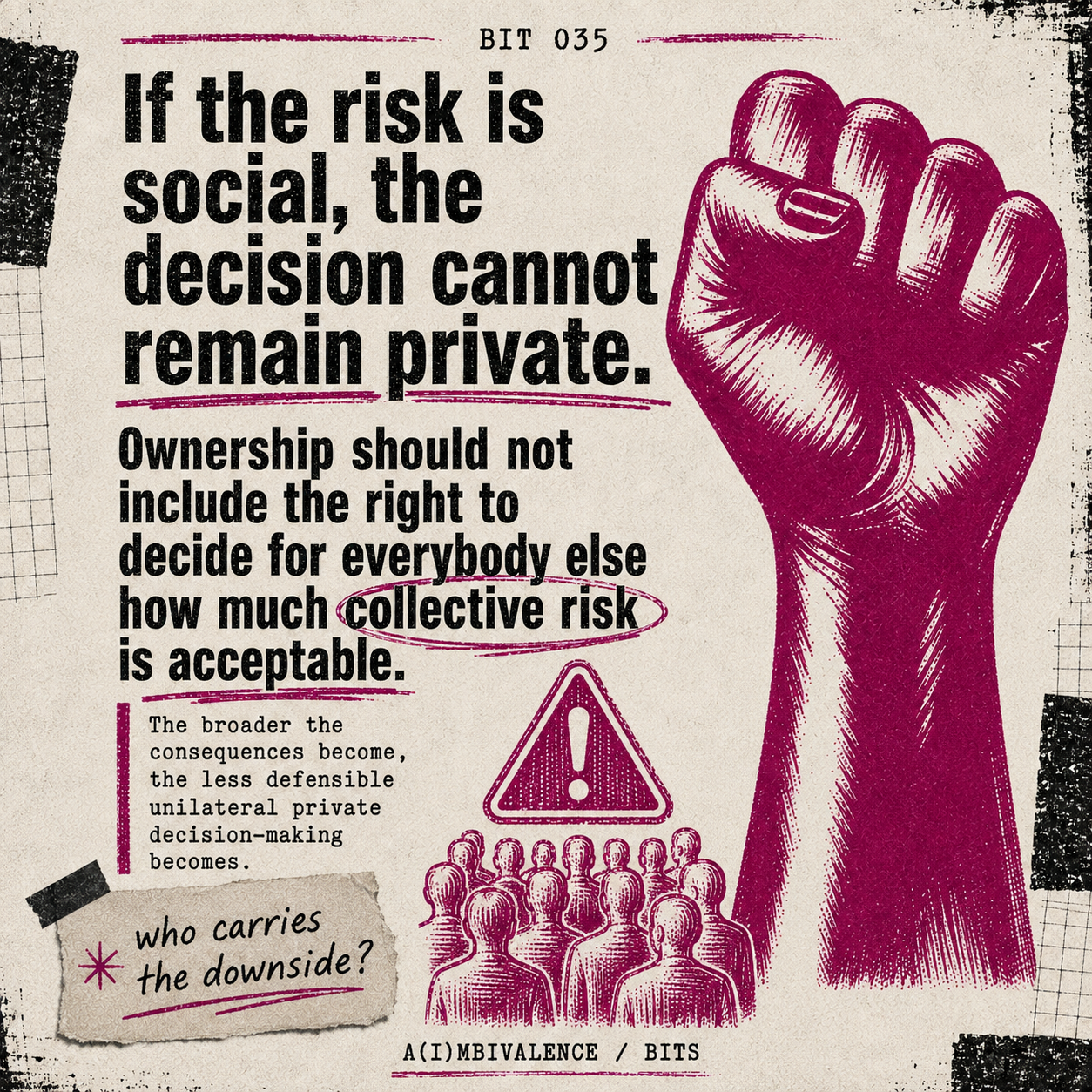
Private companies make risky decisions every day, and that is not automatically a political problem. If the consequences of a bad decision primarily fall on the company and its owners, there is at least some symmetry between decision and risk. AI becomes more complicated when companies themselves describe possible consequences that extend far beyond their own balance sheets.
If a system can affect labor markets, critical infrastructure, information environments, cybersecurity or other parts of society, then the people deciding how much risk is acceptable are not the only people exposed to that risk. A company can capture much of the upside of moving quickly while distributing parts of the downside across workers, governments, communities and the public. At that point, “it is our technology” becomes a remarkably weak argument for unilateral decision-making.
Ownership gives companies many rights. It should not give them the right to decide on behalf of everybody else how much collective risk is acceptable. The broader the possible consequences become, the less defensible it is to treat development decisions as ordinary private business decisions. If the risk is social, the decision cannot remain private.