BIT 025
Bureaucracy Loves AI
September 24, 2026
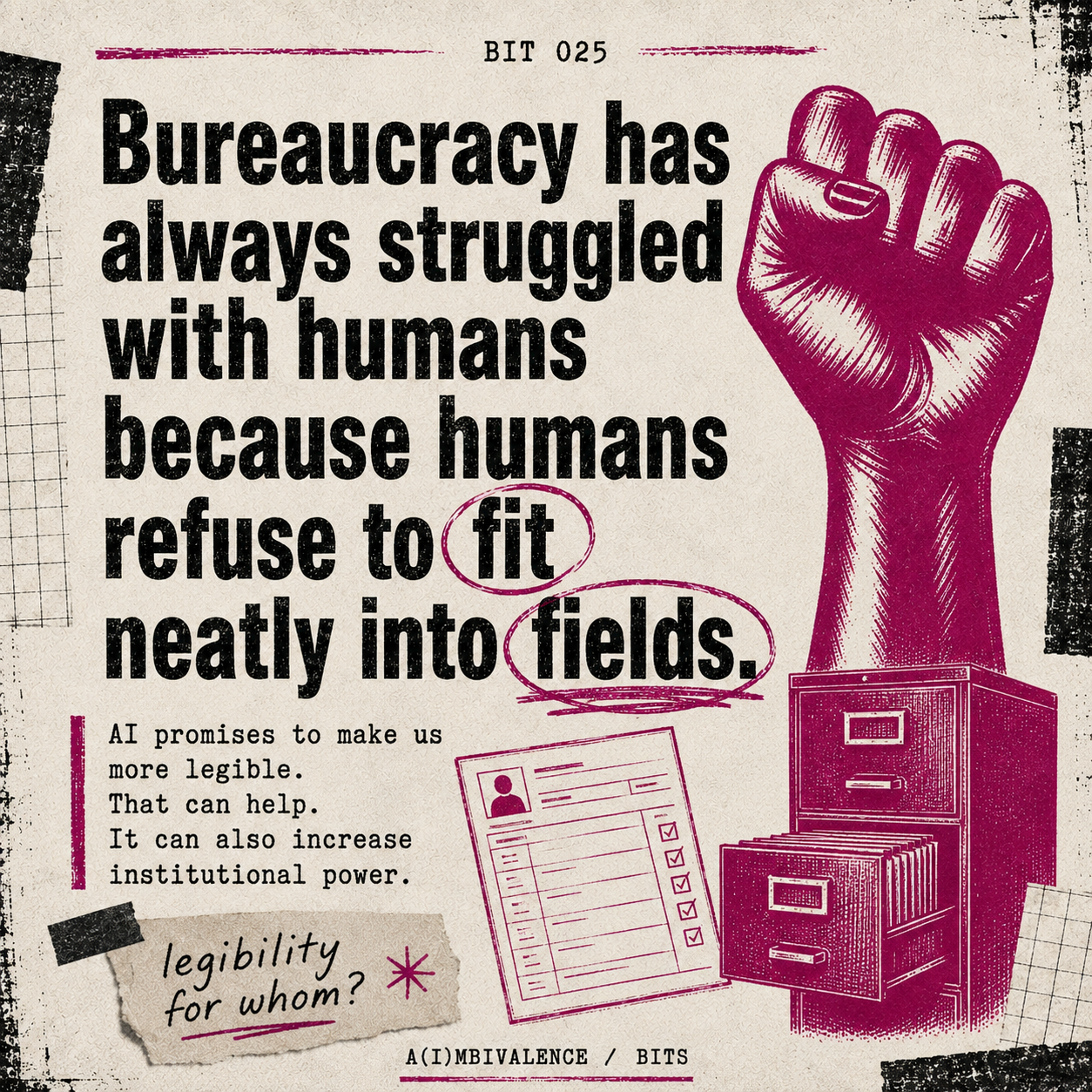
Bureaucracies have always had a problem with humans: humans are messy. Their circumstances do not fit neatly into fields, they provide irrelevant information, forget relevant information, contradict themselves, require exceptions and occasionally insist that the category assigned to them is simply wrong. Institutions, meanwhile, need legibility. They need cases that can be compared, categorized, routed, measured and processed at scale.
AI is exceptionally promising for this. It can turn correspondence into structured data, summarize complex histories, classify requests, detect patterns, recommend decisions and translate the peculiarities of an individual life into something an institution can process. Some of this could make bureaucracy dramatically less painful. Anyone who has spent hours trying to explain the same situation to three departments should be allowed to appreciate that possibility.
But making people more legible to institutions also increases institutional power. The danger is not necessarily an evil bureaucracy deliberately trying to make citizens stupid. It is something much more ordinary: systems optimized for scale tend to prefer the person who fits the model. The political question is therefore what happens to the person who does not. Efficiency is easy when humans become standardized cases. A democratic institution proves itself in what it does when a human being refuses to fit.